Time Clock Rounding and Early Punch-Ins: What Federal Rules Allow
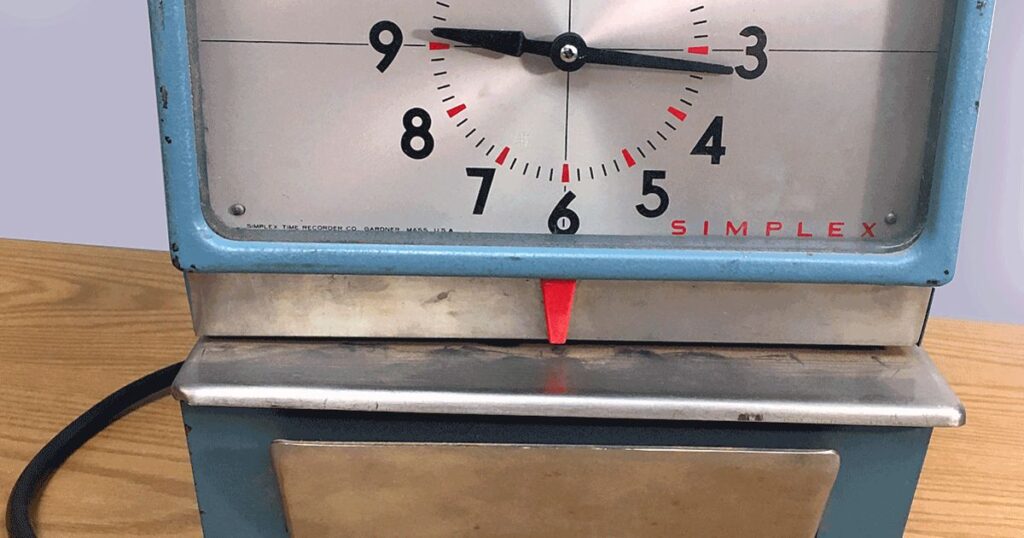
Time clock rounding and early punch-ins: what federal rules allow
Many payroll systems round punches — 8:53 becomes 9:00, 5:07 becomes 5:00. Is that legal? Under the federal Fair Labor Standards Act, rounding is accepted only on a condition. The Labor Department’s interpretations are in 29 CFR 785.48 (time clocks) and 29 CFR 785.47 (insignificant periods of time).
- 29 CFR 785.48(a): time clocks are not required. Employees who voluntarily punch in early or stay late do not have to be paid for that time if they do no work.
- Minor differences between clock records and actual hours worked cannot ordinarily be avoided, but major discrepancies should be discouraged because they raise doubt about the accuracy of records.
- 29 CFR 785.48(b): rounding to the nearest 5 minutes, or the nearest tenth or quarter of an hour, is accepted for enforcement only if it does not, over a period of time, result in failure to compensate employees for all time actually worked.
- 29 CFR 785.47: only uncertain and indefinite periods of a few seconds or minutes may be disregarded as de minimis; an employer may not arbitrarily fail to count any part of regular working time.
Early and late punches
29 CFR 785.48(a) says time clocks are not required. Where they are used, employees who voluntarily come in before their regular starting time or remain after closing time do not have to be paid for those periods, “provided, of course, that they do not engage in any work.” Their early or late punching may be disregarded. The key word is work: if you start setting up, logging in or answering questions after you punch, that time counts.
Rounding rules
29 CFR 785.48(b) notes that in some industries, particularly with time clocks, employers have long recorded start and stop times to the nearest 5 minutes, or to the nearest one-tenth or quarter of an hour. “Presumably, this arrangement averages out.” For enforcement purposes the practice is accepted, “provided that it is used in such a manner that it will not result, over a period of time, in failure to compensate the employees properly for all the time they have actually worked.”
In practice, that means rounding has to be neutral. A policy that always rounds in the employer’s favor — down at the start and down at the end — is the kind of practice that can fail the test over time.
De minimis time
29 CFR 785.47 allows insubstantial or insignificant periods beyond scheduled hours, which cannot as a practical matter be precisely recorded, to be disregarded. It applies only to uncertain and indefinite periods of a few seconds or minutes, justified by industrial realities. An employer may not arbitrarily fail to count any part, however small, of the employee’s fixed or regular working time. Among the decisions the regulation cites is one holding that 10 minutes a day is not de minimis.
Check your own time records
- Compare your actual punch times with the rounded times on your pay stub for a few weeks.
- Note any tasks you do before punching in or after punching out.
- If rounding consistently cuts minutes in one direction, ask payroll how the policy is applied.
Related: meal and rest breaks under the FLSA and whether training time is paid. State law may add stricter rules. General information, not legal advice.
Header image: Photo: “Simplex-Time-Recorder-time-clock” by Jonathan Mauer, CC BY-SA 4.0 (cropped).
Related guides
Sleep Time on 24-Hour Shifts: When Federal Law Says It Must Be Paid
Under federal FLSA rules, an employee on duty for less than 24 hours is working even if allowed to sleep. On shifts…
Can Your Employer Average Overtime Over Two Weeks? The FLSA Workweek Rule
No. Federal rules take a single workweek as the standard and do not permit averaging hours over two or more weeks. A…
The Portal-to-Portal Act: When Commute Time and Before-Shift Tasks Are Not Hours Worked
29 U.S.C. 254, part of the Portal-to-Portal Act, relieves employers of FLSA minimum-wage and overtime liability for ordinary commuting and for certain…