Meal and Rest Breaks: What the Federal FLSA Hours-Worked Rules Actually Require
Meal and rest breaks: what the federal FLSA hours-worked rules actually require
Many employees assume federal law guarantees a lunch break. The Fair Labor Standards Act’s hours-worked rules, in 29 CFR part 785, are narrower than that. They mainly answer a different question: if a break is given, does it count as paid working time?
- {R18} addresses rest periods. Rest periods of short duration, running from 5 minutes to about 20 minutes, are common in industry and must be counted as hours worked.
- {R19} addresses meal periods. Bona fide meal periods are not worktime. The regulations state that ordinarily 30 minutes or more is long enough for a bona fide meal period, and that the employee must be completely relieved from duty for the purposes of eating regular meals. Bona fide meal periods do not include coffee breaks or time for snacks; those are rest periods.
- The employee is not relieved if required to perform any duties, whether active or inactive, while eating.
- These sections do not, by themselves, require a private employer to provide a meal break. Some states do. This is not legal advice.
Short rest periods are hours worked
29 CFR 785.18, rest is a short, direct rule. It says that rest periods of short duration, running from 5 minutes to about 20 minutes, are common in industry. They promote the efficiency of the employee and are customarily paid as working time. They must be counted as hours worked. Compensable time of rest periods may not be offset against other working time such as compensable waiting time or on-call time.
Bona fide meal periods are not worktime
29 CFR 785.19, meal(a) says bona fide meal periods are not worktime. Bona fide meal periods do not include coffee breaks or time for snacks. These are rest periods. “The employee must be completely relieved from duty for the purposes of eating regular meals. Ordinarily 30 minutes or more is long enough for a bona fide meal period. A shorter period may be long enough under special conditions.” The employee is not relieved if required to perform any duties, whether active or inactive, while eating. For example, an office employee who is required to eat at a desk or a factory worker who is required to be at a machine is working while eating. It is not necessary that an employee be permitted to leave the premises if the employee is otherwise completely freed from duties during the meal period.
29 CFR 785.16, off duty separately discusses periods when the employee is off duty. Together, these sections are about how to count time, not about a federal mandate that every workplace must schedule a lunch.
What this means at work
If your employer gives you a 10- or 15-minute rest break, federal hours-worked rules treat that time as paid working time. If you are given a meal period of 30 minutes or more and you are completely relieved of duty, that time is not hours worked under 29 CFR 785.19. If you have to watch a station, answer a phone, or stay on call in a way that is not complete relief from duty, the meal period may have to be counted as worktime. State laws can require meal or rest breaks that federal law does not. Check your state. This page is educational, not legal advice.
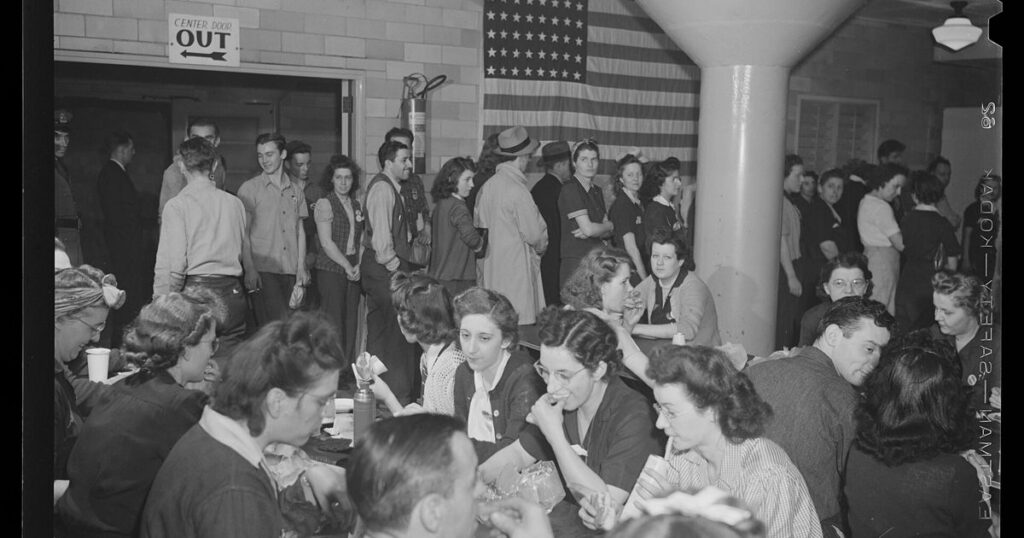
Header image: Photo: “Employees eating during their half hour lunch period in the plant-operated cafet” by Marjory Collins, PUBLIC DOMAIN (cropped).
Related guides
The Portal-to-Portal Act: When Commute Time and Before-Shift Tasks Are Not Hours Worked
29 U.S.C. 254, part of the Portal-to-Portal Act, relieves employers of FLSA minimum-wage and overtime liability for ordinary commuting and for certain…
How the FLSA Tip Credit Works for Tipped Employees
Federal law lets some employers pay a tipped employee a cash wage below the full minimum wage if tips make up the…
Highest-Paying Jobs Without a College Degree in Lansing (2025 BLS Data)
The best-paying jobs in Lansing that don't need a bachelor's degree, using May 2025 BLS wage data: no-degree jobs, certificate and associate's…