Year-End Review Season: 87% of Companies Use Your Rating to Set Your Raise. Here’s How to Write a Self-Review That Moves It

For most office workers, late November and December are review season. Managers are filling out rating forms, employees are being asked for self-assessments, and compensation teams are quietly lining up the numbers that will show up in paychecks in January or March. If you treat your self-review as paperwork, you are leaving money on the table, because this year’s salary surveys make one thing clear: the rating you walk out with is what decides your raise.
Here is what the latest data says about how 2027 raises will be split, and a practical way to write a self-review that pushes your rating, and your pay, in the right direction.
Your rating is the main input for your raise
Compensation software company Pave and Alpine Rewards surveyed 251 companies about their 2027 plans. The median merit budget is 3.5%, the same as in 2025 and 2026. How that pool gets divided is the bigger story: 87% of the companies use performance ratings to set individual merit increases. Fewer look at where you sit against the market (59%) or inside your pay range (49%), and only 9% hand everyone the same flat raise.
The same survey found promotion and adjustment budgets are shrinking, from 1.8% of payroll in 2026 to 1.5% planned for 2027. In plain terms, there is less money set aside for promotions, so the annual merit increase carries more weight than usual.
The Talent Strategy Group’s 2026 Performance Management Report shows how built-in this link is. Of organizations that formally review performance, 92.4% use ratings, and 56.3% review only once a year. Just 7.1% say they do not connect performance results to rewards at all. The most common setup (55.3%) gives managers a raise range for each rating and lets them choose within it. That discretion is where a strong self-review can help.
The gap between average and top performers is growing
Employers are moving away from “peanut butter” raises that spread the same percentage across everyone. Payscale’s 2026-2027 Salary Budget Survey found only 32% of organizations plan an across-the-board raise for 2027, down from 44% that were adopting or considering one heading into 2026. Payscale expects average increases of about 3.5% in 2027, which it says is broadly in line with inflation.
When the average just keeps pace with prices, the only way to get ahead is to land above the average. The American Society of Employers’ 2026/2027 Salary Budget Survey of Michigan employers puts a number on that: top performers averaged a 4.6% raise in 2026, up from 4.3% in 2025, while overall budgets averaged about 3.1%. Consulting firm Aon’s 2027 salary planning study, based on responses from 1,850 organizations, found 79% single out top performers for targeted pay investment, ahead of critical roles (68%) and high potentials (61%).
On a $60,000 salary, the difference between a 3.1% raise and a 4.6% raise is $900 a year, and it compounds every year after that. We break down that math further in Employers Plan 3.5% Raises for 2027. Here’s How to Get More Than the Average.
Most people undersell themselves, or oversell badly
Self-reviews have a credibility problem. A Kickresume survey of 1,365 workers published last November found 71% admitted bending the truth in their self-reviews, 26% believed self-reviews mainly exist to make employees feel involved after decisions are already made, and 72% suspected their managers use AI to write reviews. Managers know this, which is why vague praise of yourself rarely moves anyone.
What does move a manager is evidence they can copy straight into their own rating justification. Remember that your manager usually has to defend each rating to a calibration group or their own boss. Your job is to make that defense easy.
How to write a self-review that supports a higher rating
- Start with your three biggest results, not your task list. Lead with outcomes: revenue won, costs cut, hours saved, errors reduced, customers kept. Put a number on each one, even an estimate you can explain.
- Tie each result to a goal your boss cares about. Use the same words as your team’s goals or the company’s priorities for the year. A rating committee responds to “this moved the goal we were judged on.”
- Show work beyond your job description. Training new hires, covering a vacant role, or taking on a project nobody owned are the things that separate “meets expectations” from “exceeds.”
- Be honest about one miss and what you learned. A short, specific note on a setback makes the rest of your review more believable, which matters given how many people stretch the truth.
- Mention new skills with proof. Aon notes that employers are putting more weight on skills. If you learned a tool, earned a certification or started using AI to speed up your work, show the result it produced.
- Close with a forward-looking ask. Name what you want to take on next year and say plainly that you would like your compensation to reflect your results. A self-review is a written record, and it is the right place to put that on the table.
Have the pay conversation before the numbers are final
Timing matters. In many companies, merit increases are set during calibration in December or January, then announced weeks later. Once the spreadsheet is locked, a manager has little room left. Ask for a short meeting now to review your results and ask directly: “What would it take to be rated at the top level this cycle, and what raise range goes with that rating?”
If you are told the budget is tight, the ASE data gives you other levers to ask about. In the past year, 57% of employers made market adjustments outside the normal review cycle, 37% made retention or critical-skill adjustments, and 38% used lump-sum payments instead of raises, mostly for people at the top of their pay range. If a merit raise is capped, ask whether a market adjustment or a one-time bonus is possible. Our guide on cost-of-living versus merit raises explains how to tell which one you are actually getting, and how to handle objections when asking for a raise covers what to say when the first answer is no.
The bottom line
Budgets for 2027 are flat, promotion pools are smaller, and almost every company splits raises by rating. That makes the next few weeks the most valuable time of the year for your paycheck. Write a self-review with specific, numbered results, connect them to the goals you were measured on, and ask for the pay conversation before the decisions are locked in.
Sources: Pave and Alpine Rewards 2027 merit budget survey; Talent Strategy Group 2026 Performance Management Report; Payscale 2026-2027 Salary Budget Survey (Aug. 4, 2026); American Society of Employers 2026/2027 Salary Budget Survey (Aug. 24, 2026); Aon 2027 salary planning insights; Kickresume self-review survey (Nov. 2025).
Related guides
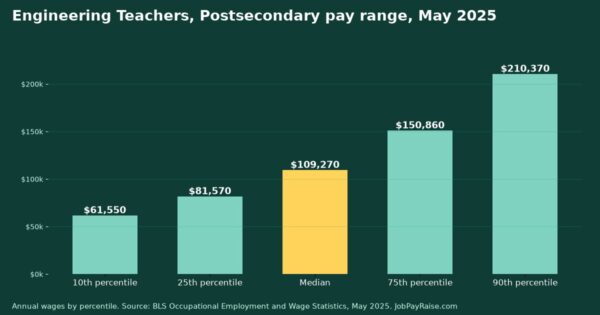
How Much Do Engineering Teachers, Postsecondary Make? 2025 Pay by Percentile, State, City and Industry
What engineering teachers, postsecondary earn in 2025: median pay of $109,270 a year, the full pay range, top-paying states, metro areas and…
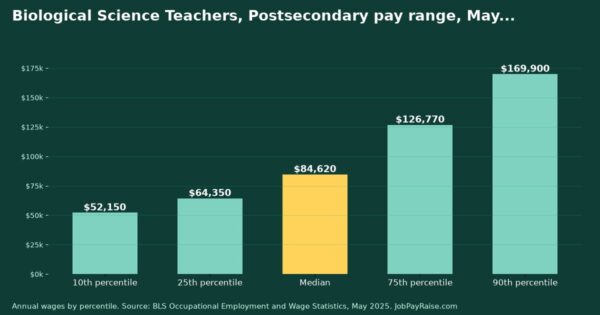
How Much Do Biological Science Teachers, Postsecondary Make? 2025 Pay by Percentile, State, City and Industry
What biological science teachers, postsecondary earn in 2025: median pay of $84,620 a year, the full pay range, top-paying states, metro areas…
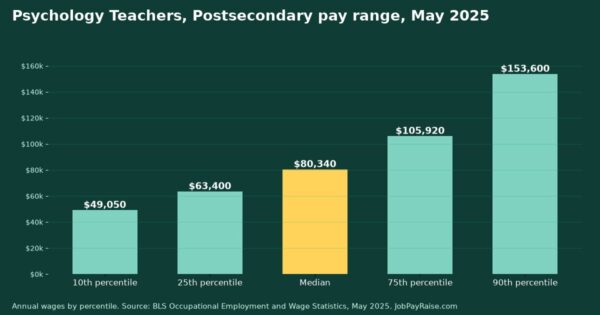
How Much Do Psychology Teachers, Postsecondary Make? 2025 Pay by Percentile, State, City and Industry
What psychology teachers, postsecondary earn in 2025: median pay of $80,340 a year, the full pay range, top-paying states, metro areas and…