Can Your Employer Make You Take a Lie Detector Test? The Employee Polygraph Protection Act Explained
Can your employer make you take a lie detector test?
If money goes missing at work, a manager might suggest everyone take a polygraph. For most private-sector jobs, federal law says no. The Employee Polygraph Protection Act (EPPA) sharply limits lie detector tests in hiring and on the job.
- Covered employers can’t require, request, suggest or cause an employee or applicant to take a lie detector test.
- They can’t use or ask about test results, or fire, discipline or refuse to hire you for refusing a test or based on results.
- Government employers are exempt, and there are limited exceptions for some security firms, controlled-substance businesses and ongoing theft investigations.
- An employer that violates the law can be assessed a civil penalty of up to $10,000.
What’s prohibited
Under 29 U.S.C. 2002, prohibitions on lie detector use, it is unlawful for a covered employer to “directly or indirectly” require, request, suggest or cause “any employee or prospective employee to take or submit to any lie detector test.” The employer also can’t use, accept, refer to or ask about test results, and can’t discharge, discipline, discriminate against or deny employment or promotion to someone who refuses a test or based on results. Retaliating against someone who files a complaint or testifies is prohibited too.
The exceptions
Under 29 U.S.C. 2006, exemptions:
- Government employers: the law doesn’t apply to federal, state or local governments.
- Ongoing investigations: an employer may request a polygraph in an investigation of economic loss or injury, like theft or embezzlement, if you had access to the property involved and the employer has a reasonable suspicion you were involved.
- Security services: certain armored car, alarm and security guard firms may test some job applicants.
- Controlled substances: employers authorized to manufacture, distribute or dispense certain controlled substances may test in limited situations.
What the employer must put in writing
For the investigation exception, before the test the employer must give you a signed statement that describes “with particularity the specific incident or activity being investigated and the basis for testing particular employees.” It must identify the specific loss, state that you had access to the property and explain the basis for the reasonable suspicion. The employer keeps it for at least 3 years. These tests are also subject to further limits in sections 2007 and 2009 of the law.
Penalties
Under 29 U.S.C. 2005, enforcement, an employer that violates the law may be assessed a civil penalty “of not more than $10,000.”
If you’re asked to take one
- Ask, in writing, which exemption the employer is relying on.
- For an investigation, ask for the written statement before the test.
- Keep notes of who asked and when.
- Contact the Department of Labor’s Wage and Hour Division or an employment attorney if you’re punished for refusing.
Related: your right to discuss pay at work.
General information, not legal advice. State laws vary; check your state labor department or an employment attorney for your situation.
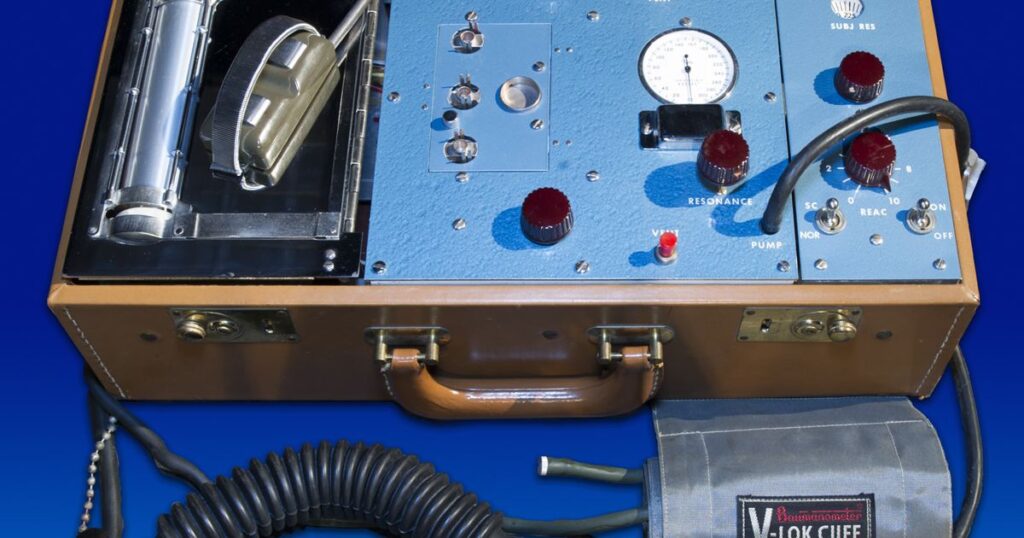
Header image: Photo: “November 2016- Polygraph Machine – Jack Ruby (31197877675)” by Federal Bureau of Investigation (FBI), PUBLIC DOMAIN (cropped).