Nursing Career Ladder Pay: CNA to LPN to RN to Nurse Practitioner (BLS 2025 Data)
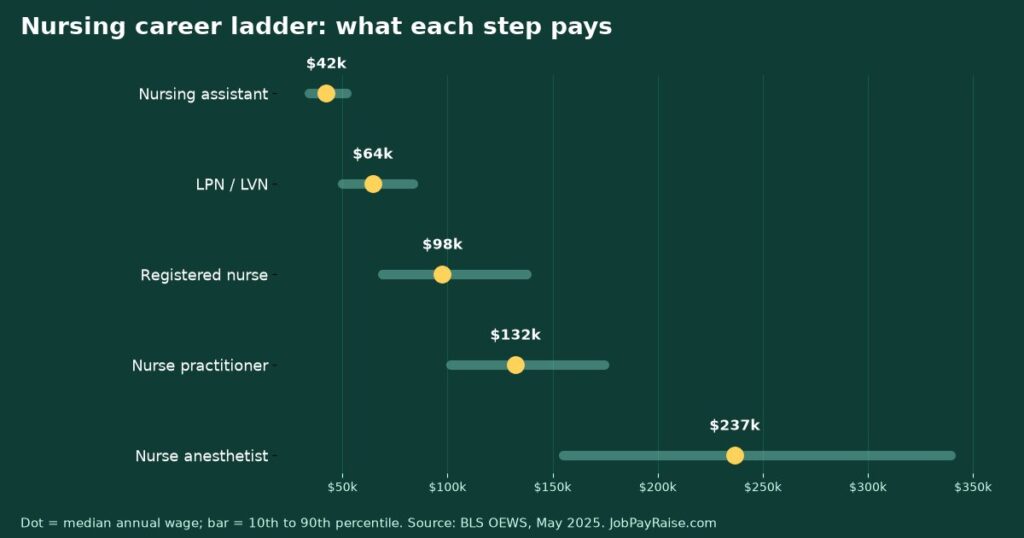
Nursing has one of the clearest pay ladders in the U.S. job market: each credential unlocks a distinctly higher pay band, and you can usually climb it while working. If you are a nursing assistant wondering whether LPN school is worth it, or an RN weighing a graduate program, the numbers below show what each step has been worth in the latest federal wage survey.
The pay ladder at a glance
| Occupation | U.S. jobs | 10th pct. | Median | 90th pct. | Typical entry education | Projected growth 2025–35 |
|---|---|---|---|---|---|---|
| Nursing assistant | 1,448,910 | $33,940 | $42,260 | $51,980 | Postsecondary nondegree award | +2.6% |
| LPN / LVN | 648,410 | $49,740 | $64,400 | $83,440 | Postsecondary nondegree award | +3.0% |
| Registered nurse | 3,379,720 | $68,940 | $97,550 | $137,470 | Bachelor's degree | +5.6% |
| Nurse practitioner | 323,040 | $101,340 | $132,300 | $174,420 | Master's degree | +41.0% |
| Nurse anesthetist | 51,840 | $155,250 | $236,590 | $339,500 | Master's degree | +9.7% |
Wages are May 2025 estimates from BLS Occupational Employment and Wage Statistics, May 2025; growth and education from BLS Employment Projections, 2025–35. The 10th and 90th percentiles show the range from entry-level or lower-paying employers to the most experienced or best-paid workers. For comparison, the median for all U.S. occupations was $50,980.
Step 1: Nursing assistant to LPN
Nursing assistants earn a median of $42,260. Becoming a licensed practical or vocational nurse typically takes a state-approved program of about one year plus the NCLEX-PN licensing exam, according to the BLS Occupational Outlook Handbook. The median jump is $22,140 a year, or about 52%.
Step 2: LPN to registered nurse
RNs earn a median of $97,550, $33,150 more than LPNs. RNs qualify through a bachelor’s degree (BSN), an associate’s degree (ADN) or an approved diploma program and must pass the NCLEX-RN. Many community colleges offer LPN-to-RN bridge programs that give credit for prior training. With 3,379,720 jobs, RN is also by far the largest occupation on this ladder, and BLS projects about 180,800 openings a year through 2035.
Step 3: RN to advanced practice (NP or CRNA)
Nurse practitioners earn a median of $132,300 and are projected to grow 41.0% from 2025 to 2035, the fastest projected growth rate of any occupation in BLS’s 2025–35 projections. Nurse anesthetists earn a median of $236,590, with the 90th percentile at $339,500. Both require an RN license, a graduate degree in the specialty, national certification and a state APRN license. BLS notes that nurse anesthesia programs require at least one year of critical-care RN experience before admission, so the CRNA path usually starts with ICU work.
Where nurse practitioners earn the most
State medians for nurse practitioners vary widely. The five highest-paying states in the May 2025 survey:
| State | Median annual wage | Employment |
|---|---|---|
| California | $168,520 | 25,120 |
| New Jersey | $159,310 | 9,950 |
| Washington | $156,100 | 6,700 |
| Oregon | $155,680 | 2,820 |
| Alaska | $155,170 | 710 |
How to use this data in a raise conversation
- Compare yourself to the right percentile. An RN with five years of experience in a high-acuity unit should be benchmarking toward the 75th percentile ($112,350), not the median.
- Count differentials separately. BLS wage estimates exclude overtime and shift differentials, so night and weekend nurses often earn more than these figures show. Compare base rates with base rates, and get differentials in writing.
- Ask about tuition help before you enroll. Many hospital systems fund LPN-to-RN and RN-to-BSN programs in exchange for a work commitment.
Published October 27, 2026. Sources are linked in the text.
Header image: original chart by JobPayRaise.com using BLS OEWS May 2025 data.
Comments (1)
One more lever the article didn't cover: if you're an RN paid hourly, you're owed overtime after 40 hours even if you hold a degree. The U.S. Department of Labor says RNs paid on an hourly basis are not exempt, while LPNs generally don't qualify for the professional exemption at all. Details are in WHD Fact Sheet #17N: Nurses and the Part 541 Exemptions. Worth checking before you agree to a switch from hourly to salary.