Nurse Anesthetists (CRNAs) vs. Anesthesiologists: Pay, Job Outlook and Training Compared (2025 BLS Data)
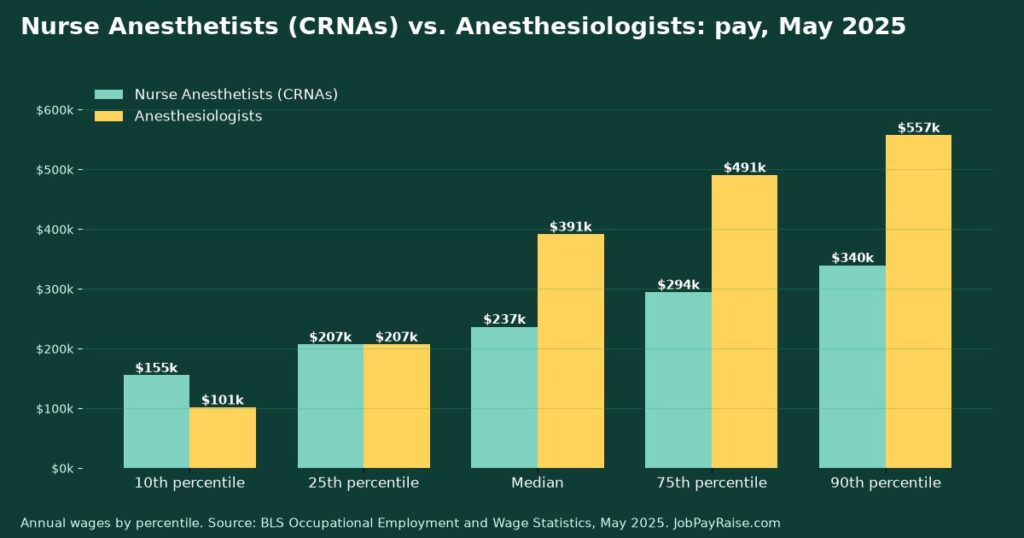
- Anesthesiologists had the higher median annual wage in May 2025: $391,490, versus $236,590 for nurse anesthetists (CRNAs).
- There are more nurse anesthetists (CRNAs): about 51,840 U.S. jobs, versus 38,760 for anesthesiologists.
- BLS projects employment of nurse anesthetists (CRNAs) to change by 9.7% and employment of anesthesiologists by 3.6% from 2025 to 2035.
Choosing between nurse anesthetists (CRNAs) and anesthesiologists, or thinking about switching? This side-by-side uses the federal government’s BLS OEWS national data, May 2025 for pay and job counts and BLS Employment Projections, 2025–35 for growth, openings and typical entry requirements. BLS occupation titles: “Nurse Anesthetists” (SOC 29-1151) and “Anesthesiologists” (SOC 29-1211). More detail: Nurse Anesthetists (CRNAs) (BLS) and Anesthesiologists (BLS).
Pay side by side
| May 2025 | Nurse Anesthetists (CRNAs) | Anesthesiologists |
|---|---|---|
| U.S. jobs | 51,840 | 38,760 |
| 10th percentile (annual) | $155,250 | $101,460 |
| 25th percentile | $206,730 | $207,000 |
| Median (annual) | $236,590 | $391,490 |
| Median (hourly) | $113.75 | $188.22 |
| 75th percentile | $294,350 | $490,530 |
| 90th percentile | $339,500 | $557,130 |
| Mean (average) | $248,320 | $360,570 |
Percentile wages: for example, 10% of workers earn less than the 10th-percentile figure. OEWS wages exclude overtime, tips and most bonuses.
Outlook and how you get in
| BLS Employment Projections | Nurse Anesthetists (CRNAs) | Anesthesiologists |
|---|---|---|
| Projected job growth, 2025–35 | 9.7% | 3.6% |
| Openings per year (avg.) | 2.4 thousand | 1.1 thousand |
| Typical entry education | Master's degree | Doctoral or professional degree |
| Work experience in a related job | none | none |
| Typical on-the-job training | none | Internship/residency |
Openings include jobs that open up when workers retire or change occupations, not just new positions, which is why a field with slow growth can still hire a lot of people every year.
Where each job pays best
The three states with the highest median wage for each occupation (BLS OEWS state data, May 2025):
| Rank | Nurse Anesthetists (CRNAs) | Anesthesiologists |
|---|---|---|
| 1 | Alaska – $341,210 | Washington – $499,990 |
| 2 | New York – $321,030 | Minnesota – $496,510 |
| 3 | Massachusetts – $295,550 | Ohio – $490,530 |
By industry, nurse anesthetists (CRNAs) earned the highest median in Health Care and Social Assistance ($236,410) and anesthesiologists in Health Care and Social Assistance ($394,050), counting sectors with at least 1,000 jobs in the occupation (BLS OEWS industry data).
Which should you pick?
- Look past the median. Compare the 25th and 75th percentiles too: they show what a typical early-career and an experienced worker earn in each field.
- Count the cost of entry. The education and training rows above tell you how long it takes to start earning. A longer path can still pay off if the pay gap is large.
- Check your area. State pay differs a lot from the national figure; use the state table and your local job ads before deciding.
- Already in one of these jobs? If your pay is below the 25th percentile for your field, that is a concrete number to bring to a raise conversation.
Published October 31, 2026. Sources are linked in the text.
Header image: original chart by JobPayRaise.com using BLS OEWS May 2025 data.
Comments (1)
One more data point, from metro-level data: among metro areas with at least 300 jobs in the occupation, the highest median for nurse anesthetists (CRNAs) was in Jacksonville, FL ($416,000, 340 jobs), and for anesthesiologists it was in Seattle-Tacoma-Bellevue, WA ($646,930, 990 jobs). Source: BLS OEWS metropolitan-area data, May 2025.
— JobPayRaise Data Desk