Manufacturing Pay Ladder: Assembler to CNC Operator to Machinist to Industrial Engineer
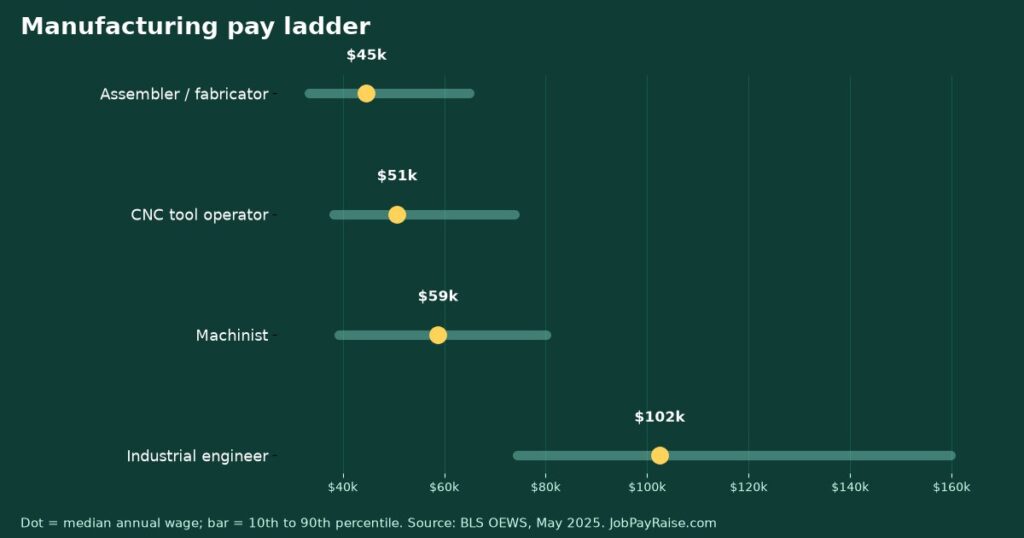
Factory work has a pay ladder that runs from the assembly line to the engineering office. The federal data shows where the biggest jumps are and which ones need school.
The pay ladder at a glance
| Occupation | U.S. jobs | 10th pct. | Median | 90th pct. | Typical entry education | Projected growth 2025–35 |
|---|---|---|---|---|---|---|
| Assembler / fabricator | 1,405,030 | $33,280 | $44,650 | $64,880 | High school diploma or equivalent | +1.1% |
| CNC tool operator | 169,450 | $38,140 | $50,690 | $73,890 | High school diploma or equivalent | -9.4% |
| Machinist | 287,050 | $39,200 | $58,750 | $80,010 | High school diploma or equivalent | +1.0% |
| Industrial engineer | 365,740 | $74,370 | $102,440 | $159,860 | Bachelor's degree | +12.4% |
Wages are May 2025 estimates from BLS Occupational Employment and Wage Statistics, May 2025; growth and education from BLS Employment Projections, 2025–35. The 10th and 90th percentiles show the range from entry-level or lower-paying employers to the most experienced or best-paid workers. For comparison, the median for all U.S. occupations was $50,980.
Assembly to CNC
Miscellaneous assemblers and fabricators earn a median of $44,650. Computer numerically controlled (CNC) tool operators earn $50,690. The BLS Occupational Outlook Handbook says a high school diploma is enough for most assembly jobs, with several months of on-the-job training.
Machinist
Machinists earn $58,750, with the 90th percentile at $80,010. BLS says machinists typically need a high school diploma and are trained on the job, though some learn through apprenticeships, vocational schools or community colleges.
Into engineering
Industrial engineers earn $102,440, and BLS projects 12.4% growth from 2025 to 2035. They typically need a bachelor’s degree in industrial engineering or a related field such as mechanical or electrical engineering.
Where machinists earn the most
State medians for machinists vary widely. The five highest-paying states in the May 2025 survey:
| State | Median annual wage | Employment |
|---|---|---|
| Hawaii | $84,410 | 260 |
| Alaska | $77,670 | 120 |
| District of Columbia | $72,900 | 160 |
| Massachusetts | $67,270 | 7,080 |
| Washington | $66,160 | 6,880 |
Raise tips for manufacturing workers
- Learn to program, not just run, the machine. BLS notes CNC tool programmers usually need coursework beyond high school; that skill is what moves operators up.
- Shift premiums. BLS wage estimates exclude shift differentials, so second- and third-shift pay can run higher than these figures.
Published October 27, 2026. Sources are linked in the text.
Header image: original chart by JobPayRaise.com using BLS OEWS May 2025 data.
Comments (1)
If your plant pays production or attendance bonuses, check your overtime rate. Under the FLSA, nondiscretionary bonuses (ones promised in advance for meeting targets) generally must be included in the regular rate used to calculate overtime, which raises your time-and-a-half rate in weeks you earn them. See WHD Fact Sheet #56C: Bonuses.