How Much Do Graduate Teaching Assistants Make? 2025 Pay by Percentile, State, City and Industry
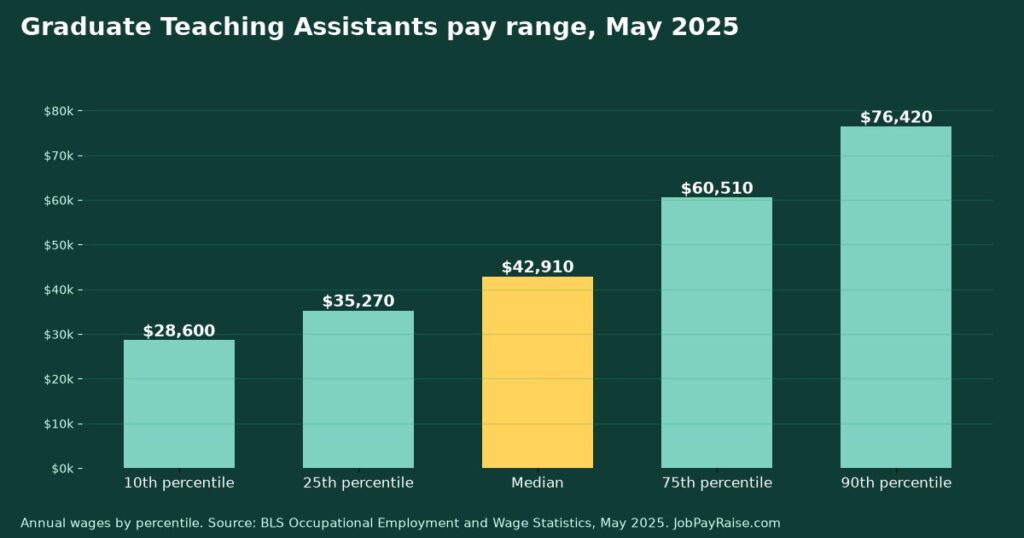
- The median annual wage for graduate teaching assistants was $42,910 in May 2025, compared with $50,980 for all U.S. occupations.
- The lowest-paid 10% earned less than $28,600; the top 10% earned more than $76,420.
- BLS projects employment to change by 2.7% from 2025 to 2035, with about 25.7 thousand openings a year.
About 164,090 people worked as teaching assistants, postsecondary in the United States in May 2025, according to the federal government’s BLS OEWS national data, May 2025. Here is what they earn, from entry level to the top of the field, and where the pay is highest. Projections and training requirements come from the BLS Occupational Outlook Handbook: Teaching Assistants, Postsecondary and BLS Employment Projections, 2025–35.
The full pay range
| Percentile | Hourly | Annual |
|---|---|---|
| 10th (entry level / lowest paid) | annual only* | $28,600 |
| 25th | annual only* | $35,270 |
| 50th (median) | annual only* | $42,910 |
| 75th | annual only* | $60,510 |
| 90th (most experienced / best paid) | annual only* | $76,420 |
| Mean (average) | annual only* | $47,670 |
A percentile wage means that share of workers earn less. For example, 25% of graduate teaching assistants earned less than $35,270. BLS wage estimates do not include overtime, tips or most bonuses.
* The OEWS program releases only annual wages for some occupations that typically work fewer than 2,080 hours per year but are paid on an annual basis, such as teachers, pilots, and athletes (BLS OEWS field descriptions, May 2025 data file).
States where graduate teaching assistants earn the most
Highest state medians in the May 2025 survey (state data):
| State | Median annual wage | Employment |
|---|---|---|
| Maryland | $58,330 | 5,030 |
| Massachusetts | $56,370 | 3,040 |
| Texas | $55,670 | 13,540 |
| New Jersey | $54,260 | 3,390 |
| Minnesota | $53,380 | 600 |
At the other end, the lowest state medians were in Alabama ($22,600), Arkansas ($23,140), Nevada ($24,960). Lower-paying states often have lower living costs, so compare offers with local prices in mind.
Top-paying metro areas
Metro areas with at least 300 jobs in this occupation, ranked by median wage (metro data):
| Metro area | Median annual wage | Employment |
|---|---|---|
| Canton-Massillon, OH | $78,510 | 310 |
| Lubbock, TX | $64,160 | 1,830 |
| Sacramento-Roseville-Folsom, CA | $61,780 | 4,800 |
| Buffalo-Cheektowaga, NY | $61,540 | 330 |
| Washington-Arlington-Alexandria, DC-VA-MD-WV | $58,330 | 4,290 |
How to get into the field
- Typical entry education: Bachelor's degree.
- Work experience in a related occupation: none.
- Typical on-the-job training: none.
These are the typical requirements BLS assigns to the occupation in its BLS Employment Projections, 2025–35 tables; employers and state licensing boards may require more. The BLS Occupational Outlook Handbook: Teaching Assistants, Postsecondary explains licensing and certification in detail.
Using these numbers to ask for a raise
- Find your band. If you earn less than $35,270, you are in the bottom quarter nationally. If you have several years of experience, that is a fact worth raising in a pay review.
- Use local data, not national. State and metro medians above can be far from the national $42,910. Quote the figure for your area.
- Compare industries. If another sector pays your occupation more, that is useful leverage, or a sign it may be worth moving.
- Count the whole package. These figures exclude overtime and benefits, so compare total compensation when weighing an offer.
Published November 9, 2026. Sources are linked in the text.
Header image: original chart by JobPayRaise.com using BLS OEWS May 2025 data.
Comments (1)
One more data point: the metro area where graduate teaching assistants are most concentrated is Ann Arbor, MI, with a location quotient of 55.45 and 12,860 jobs at a median of $38,990. A location quotient above 1 means the job is a bigger share of local employment than it is nationally, which usually means more employers competing for experienced workers. Source: BLS OEWS metropolitan-area data, May 2025.
— JobPayRaise Data Desk