Highest-Paying Jobs Without a College Degree in North Carolina (2025 BLS Data)
- The median wage for all jobs in North Carolina was $47,970 in May 2025, below the U.S. median of $50,980.
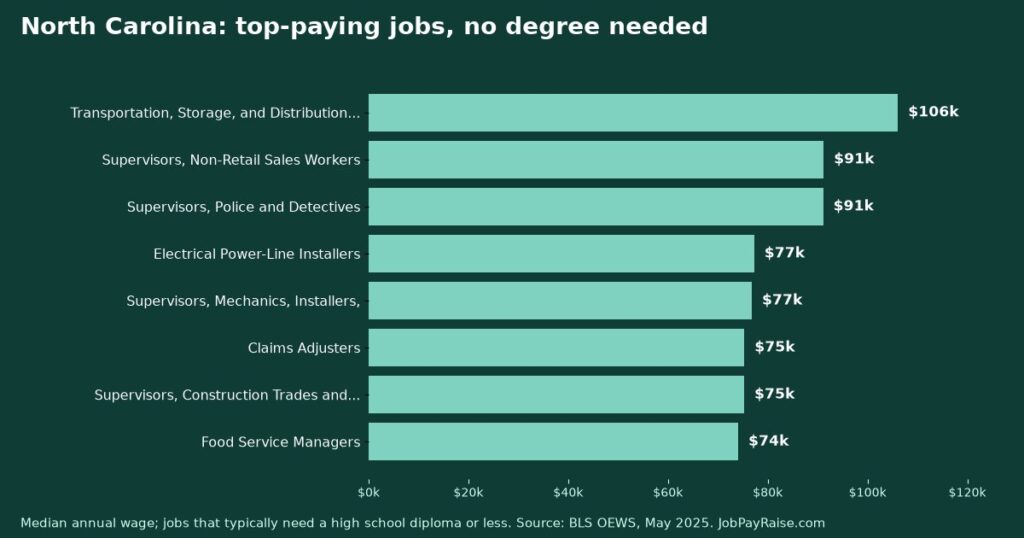
- The best-paid job here that typically needs only a high school diploma or less was transportation, storage, and distribution managers, at a median of $106,100.
- Short training programs and associate’s degrees open another tier, led by commercial pilots at $127,310.
You don’t need a four-year degree to earn well in North Carolina. Using the federal government’s most recent occupational wage survey (BLS OEWS May 2025 estimates for North Carolina) and the education level BLS lists as typical for entry into each job (BLS Employment Projections, 2025–35), here are the best-paying jobs in the state that don’t require a bachelor’s degree. North Carolina had about 4,941,820 wage and salary jobs in the survey.
Top-paying jobs that need a high school diploma or less
Jobs with at least 1,000 positions in the state, ranked by median annual wage. The last column shows the national median for comparison.
| Occupation | North Carolina median | Jobs | U.S. median |
|---|---|---|---|
| Transportation, Storage, and Distribution Managers | $106,100 | 6,650 | $107,230 |
| First-Line Supervisors of Non-Retail Sales Workers | $91,200 | 11,080 | $87,520 |
| First-Line Supervisors of Police and Detectives | $91,100 | 4,820 | $106,040 |
| Electrical Power-Line Installers and Repairers | $77,270 | 5,650 | $95,320 |
| First-Line Supervisors of Mechanics, Installers, and Repairers | $76,800 | 21,110 | $79,860 |
| Claims Adjusters, Examiners, and Investigators | $75,310 | 9,880 | $78,000 |
| First-Line Supervisors of Construction Trades and Extraction Workers | $75,270 | 32,460 | $79,920 |
| Food Service Managers | $74,080 | 9,420 | $69,390 |
| Sales Representatives, Wholesale and Manufacturing, Except Technical and Scientific Products | $70,990 | 49,110 | $72,080 |
| Executive Secretaries and Executive Administrative Assistants | $70,140 | 8,890 | $76,590 |
| First-Line Supervisors of Production and Operating Workers | $69,640 | 22,240 | $74,450 |
| First-Line Supervisors of Correctional Officers | $67,270 | 1,090 | $77,970 |
Many of these jobs pay well because they come with long on-the-job training, licensing, physical risk or irregular hours. Several are skilled trades that train through paid apprenticeships.
Top-paying jobs that need a certificate or associate’s degree
Jobs where BLS lists a postsecondary certificate, some college or an associate’s degree as the typical entry credential:
| Occupation | North Carolina median | Jobs | U.S. median |
|---|---|---|---|
| Commercial Pilots | $127,310 | 1,520 | $123,220 |
| Dental Hygienists | $97,850 | 6,690 | $98,100 |
| Diagnostic Medical Sonographers | $86,010 | 2,970 | $96,590 |
| Magnetic Resonance Imaging Technologists | $85,120 | 1,180 | $95,480 |
| Respiratory Therapists | $80,090 | 4,630 | $82,280 |
| Aircraft Mechanics and Service Technicians | $76,980 | 4,700 | $79,870 |
| Electrical and Electronics Repairers, Commercial and Industrial Equipment | $76,740 | 1,660 | $74,090 |
| Electrical and Electronic Engineering Technologists and Technicians | $76,040 | 2,490 | $78,190 |
The most common jobs in North Carolina, for context
The largest occupations by employment, and what they pay locally:
| Occupation | Median | Jobs |
|---|---|---|
| Retail Salespersons | $31,370 | 127,540 |
| Laborers and Freight, Stock, and Material Movers, Hand | $38,230 | 116,720 |
| Registered Nurses | $84,350 | 111,120 |
| Cashiers | $28,880 | 106,440 |
| Fast Food and Counter Workers | $28,570 | 92,230 |
| Customer Service Representatives | $40,240 | 89,510 |
| Stockers and Order Fillers | $35,950 | 87,510 |
| Cooks, Fast Food | $27,190 | 81,980 |
How to use these numbers
- Medians are midpoints. Half of workers in each job earn more and half earn less; new workers usually start well below the median.
- Overtime is not included. BLS wage estimates exclude overtime pay and shift differentials, so jobs with heavy overtime often pay more in practice (see the OEWS technical notes).
- Check the training path. “Typical entry education” is what most new workers have; licenses and apprenticeships may still be required.
Published October 27, 2026. Sources are linked in the text.
Header image: original chart by JobPayRaise.com using BLS OEWS May 2025 data.
Comments (1)
One more data point from the same survey: the occupation most concentrated in North Carolina relative to the nation is textile knitting and weaving machine setters, operators, and tenders, with a location quotient of 6.6. That means those jobs make up about 6.6 times as large a share of local employment as they do nationally. There are about 2,730 of them locally, at a median of $36,700. Source: BLS OEWS May 2025 estimates for North Carolina.